
Developing a Marketing Strategy: The Complete Guide

Updated: 6 days ago

Table of Contents
Part 1: Market Development
Part 2: Brand Positioning
Part 3: Measures
Part 4: Implementation and Controlling
Market Development
Market Analysis and Trend Analysis
The Market Analysis
A well-founded marketing strategy always starts with a market and trend analysis.
In the market analysis, the following questions need to be clarified:
What is it about in the first place – a product or a service?
Is it about business-to-business (B2B) or business-to-consumer (B2C)?
Does the market for it already exist, or is a new market being created?
How big is the market? (Potential target audience)
How high is the estimated repurchase rate?
How big is the market for used products?
A good orientation here is Porter’s Five Forces model:

It serves to analyze the attractiveness of an industry and the intensity of competition within a market.
Instead of only looking at direct competition, Porter considers five central forces that influence the success and profitability of a company:
Suppliers
How strongly can suppliers dictate prices or conditions?
Factors:
Number of suppliers
Availability of substitute materials
Dependence of the companies.
Competition within the industry
How strong is the competition between existing providers?
Factors:
Number of competitors
Market share of competitors
Brand strength of competitors
Customers
How strongly can customers influence prices, quality, or service?
Factors:
Number of buyers
Price awareness
Switching costs
New entrants
How easily can new providers enter the market?
Factors:
Capital requirements
Economies of scale
Brand access
Legal hurdles
Substitutes
How high is the risk that other products replace your own?
Factors:
Value for money
Technological developments
Customer preferences
Degree of innovation
Only if there is a suitable market for the product or service can it be marketed.
The Trend Analysis
The trend analysis builds on this and deals with current developments in the market:
What new trends are there?
What new innovations are there in the market?
Is the market growing? Is the market saturated? Or is the market shrinking?
A trend analysis can only partially be shown in graphs. Market growth or the growth of individual market segments can be shown quantitatively.
But new trends, innovations, and market changes can hardly be expressed in numbers. That is why people often fall back on trend reports. The various developments are assessed and corresponding recommendations are made.
Only if the market has potential is it worth investing in it.
Competitor Analysis
The competitor analysis deals with the existing companies in the market, if there are any already.
But as long as you don’t bring a real innovation to the market, that is usually the case.
The following questions need to be clarified:
Which competitors are there on the market?
How big is each one’s market share?
How strong are the brands of the respective competitors?
Are the competitors already running Meta Ads?
Which promises are out there in the market?
Where do white spaces exist?
Which content performs on social media – and why?
The competitor analysis serves to find out how similar brands position themselves in the advertising space. This includes creative strategies, targeting, offer structure, and messaging. The goal is not copy/paste, but differentiation:
This creates a data-driven foundation for the marketing strategy.
The strategies of market competitors are a double-edged sword.
On the one hand, they offer corresponding best practices you can orient yourself by; on the other hand, you also want to try to differentiate yourself from these strategies.
Otherwise there is a risk of coming across like everyone else.
You want to prevent that.
Developing Personas
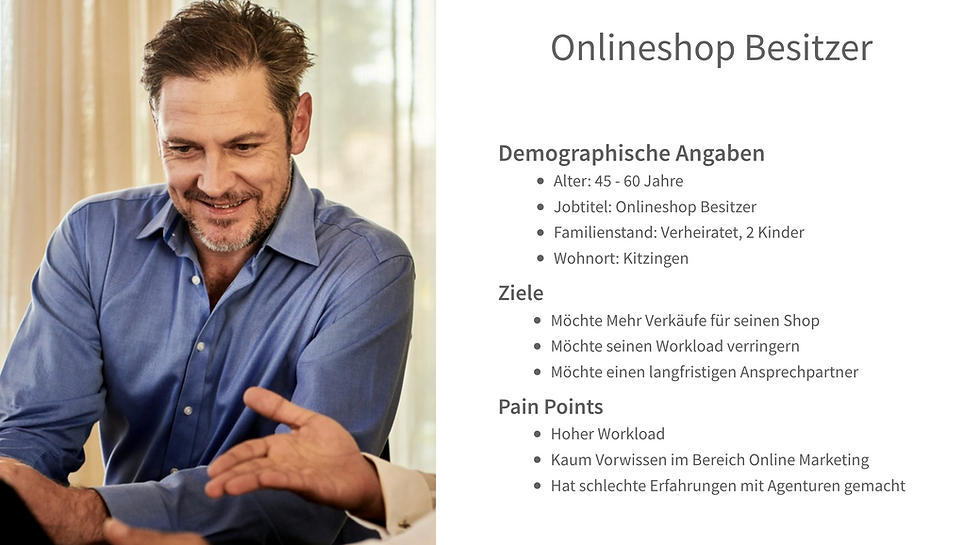
A successful marketing strategy doesn’t address “everyone” but specifically defined target personas.
Personas help you understand real needs, pain points, motivators and purchase barriers – and later translate them into creatives & copy. The clearer the persona, the higher the relevance of the ad.
The mistake most people make when conceptualizing a marketing strategy: they focus far too much on finding alliterations for the names, such as “Business Bastian” and “Housewife Helga,” and describing the people demographically, instead of dealing with their deep-seated needs and pain points.
These are exactly the factors that will really help you with your marketing strategy.
Here is an example of a persona:
Brand Positioning
Positioning
Positioning defines the place a brand occupies in the minds of the target audience. For your marketing strategy, this is crucial because ads have to be understood within milliseconds. Clear positioning ≠ just a nice design, but the deliberate answer to: “Why should anyone choose exactly you – and not the competitor?”
It also ties directly into the competitor analysis.
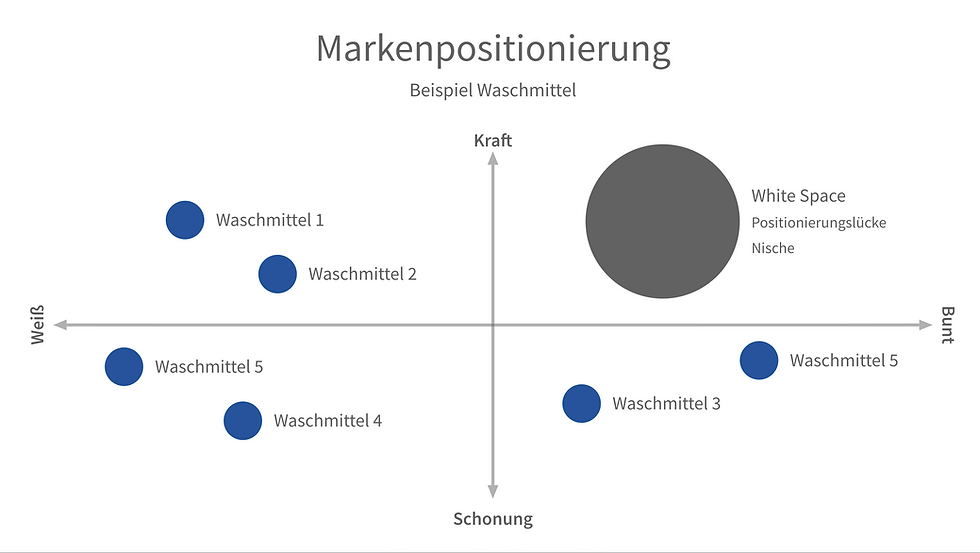
In the best case, you have chosen a white space in the competitive landscape for your positioning. That is, a position that no market competitor occupies yet. In plain terms: you have chosen a niche.
That makes it easier to set yourself apart from market competitors.
Here is another example of a graphic representation of brand positioning:
Brand Message
The brand message translates the positioning into communication. Short, concise statements that users understand immediately. Successful marketing strategies work with a single core promise that is reflected in all texts and images.
Clarity beats complexity.
Unique Selling Propositions (USPs)
USPs are the core of your entire strategy. Without USPs, you can’t expect any success.
They are clear performance promises that set you apart from the competition.
If you can’t answer the question: “Why should anyone buy from me instead of from my competitors?” you should think your business concept through again thoroughly.
Even the best ads can’t make up for missing USPs.
For Meta Ads, they must be:
quickly graspable
tangible
and noticeable
– ideally not just claimed, but backed up by proof points: cases, social proof, numbers.
The more concrete, the more credible.
SWOT Analysis
A SWOT analysis (strengths, weaknesses, opportunities, threats) helps to deliberately prioritize the strategic direction of the campaigns. It reveals where competitive advantages can be used and where weaknesses need to be compensated.
Graphic example of a SWOT analysis

For a good SWOT analysis, 2 things are important:
You have to be honest with yourself about your own weaknesses. Too much arrogance only creates a blind spot. Many companies want to put themselves in the best light and therefore often keep quiet about their own weaknesses. But that doesn’t help anyone. After all, you want to achieve exactly the opposite, namely: to reduce the blind spot.
Rely on facts, not on claims. A SWOT analysis is often simply discussed together in a meeting. But if you really want to create a meaningful SWOT analysis, you need a corresponding data foundation.
The Measures
Defining the Customer Journey
The customer journey, i.e. the path a customer takes, is a concept that tries to show which touchpoints a potential customer goes through with your own company. From the ad all the way to closing the sale.
With the customer journey, you therefore try to picture in which phase a user needs what information and how to design the individual touchpoints as sensibly as possible.
The bigger the company, the bigger the number of possible touchpoints.
This is where the customer journey helps you not to lose track.
The customer journey should always be as streamlined as possible, that is:
The customer journey must be as long as necessary and as short as possible.
Unnecessary touchpoints cause customers to drop off because the effort is too great for them.
Missing touchpoints mean that customers lack the necessary information or the necessary persuasion to consider your product.
This is especially important in online marketing because you lose users quickly. Every form, every additional web page, every additional piece of data causes users to drop off.
That is why a well-thought-out customer journey is essential for the success of your marketing strategy.
Defining the Creative Strategy
The creative strategy is the graphic foundation for every campaign. It describes how you communicate: which formats, which style, which hooks and which user promises. Good creatives are not “pretty” – they are functional and contribute to a clear campaign goal.
Selecting Social Media Channels
You should never start with all channels. In most cases, that isn’t necessary anyway.
The selection is guided by usage intentions, audience behavior, and purchase decision processes. Meta (Facebook/Instagram), TikTok, LinkedIn, Pinterest & Co. need different approaches, both creatively and strategically.
Planning the Campaign Setup
The actual heart of the whole strategy.
A clean setup largely determines performance, and all the previous points must ultimately be reflected here.
The central questions of the campaign setup are:
What are my business goals?
Which campaigns do I need for them?
Which conversions should the campaigns optimize for?
In which countries do I want to advertise?
That is different for every company.
For small companies, a single campaign is often enough, but large companies often need more.
Here, too, less is more.
Implementation and Controlling
What good is the best marketing strategy without a plan for correct implementation?
Exactly, nothing.
Creating a Roadmap
The value of a marketing strategy depends on its implementation. The best way to do that is to define a roadmap.
Creating a roadmap
What Is a Roadmap?
The roadmap defines when which measures are implemented – from setup through testing to scaling. It creates clear priorities and prevents busywork.
It also lets you track whether you are ahead of or behind schedule.
Contents of a roadmap
A roadmap breaks down the individual steps of a project or, in this case, the implementation of the strategy. It should always answer the following questions:
What needs to be done?
Who is responsible for a task?
When can a task be started?
What is the status of a task?
Certain tasks can be started and worked on in parallel, while others depend on previous tasks. This always has to be taken into account.
Presentation of the roadmap
What is the best way to present a roadmap?
There are various options, but basically a roadmap is best presented as a Gantt chart, also known as a waterfall diagram. Characteristic of it are the overlapping horizontal bars that represent the individual project steps

It can be an ordinary Word file, but an Excel sheet or a special program is better suited. The example was created with beautiful.ai.
Many project management tools such as Trello or ClickUp offer the option to display tasks on a timeline. This is especially suitable for large and complex projects.
Budget Planning
An essential part of every marketing strategy is budget planning.
After all, with the strategy you try to use the planned budget as efficiently as possible.
Contents of Budget Planning
Budget planning always includes three parts:
The Annual Overview
It’s best to start budget planning with the annual overview.
So you distribute the amount X across the 12 months.
In doing so, you should above all take the company’s seasonal factors into account, such as peak times around Black Friday, Christmas, or other relevant phases.
It also helps to orient yourself by the previous years’ budgets.
This gives you an overview of the individual monthly budgets (annual overview including channel split):

The Channel Split
Building on the monthly budgets, you divide the budget among the respective channels (channel split).
This lets you determine the weighting of the individual channels.
Recommendation: Here you should orient yourself by the CPLs (cost per lead), or the lead-to-sale ratio (sales from leads). Of course, you should invest in the channels that bring the best (or most) leads.
If you don’t have a data foundation, I recommend a balanced split, which you then adjust to channel performance over time.
This gives you an overview of how much budget each channel has available in a given month.
You can find the example in the annual overview.
The Campaign Split
Once you have the monthly budget of the individual channels, you can distribute this amount among the individual campaigns that you have defined in your campaign setup.
What matters here is above all the focus of the individual channels.
More branding or more performance?
Which goals are being pursued: conversions, leads, applications?
This gives you an overview of how much budget each campaign has available in a given month.
If you divide this amount by the number of days in the respective month, you get the respective daily budget:

With this scheme, you can calculate the daily budget of each individual campaign for every month of the year.
Now you can plan properly!
Presenting the Budget Plan
For budget planning, I recommend working with an Excel sheet.
That way you can keep track with the appropriate tables.
You can find the examples in the collapsible text.
Pro tip:
It’s best to work with as many formulas as possible so you can adjust the planning as easily as possible when things change.
And believe me, there are always changes to the budget.
A dynamic budget planning file makes your life much easier.
You can find more information on how to create a budget plan in this article:
Process Planning
No marketing strategy helps you without the corresponding processes. Otherwise it simply fizzles out.
The most important questions are:
Who takes on what?
Who coordinates the project?
How long do the individual tasks take?
This results in the magic formula: people, processes, capacities.
People
The bigger the project, the more people or entire departments are needed. The following areas of responsibility are usually required:
Media buying (running the ads)
Graphic design
Copywriting
Project management
Depending on what is being promoted, you also need a web designer, or other experts.
Processes
Depending on which tasks arise, it also has to be defined how they need to be completed.
Capacities
Everyone has other tasks as well. To avoid bottlenecks, capacities should be planned in advance.
Creative development, copywriting, approval processes, reporting: everything needs to be organized.
A clear process saves time and prevents mistakes.
Setting Up Reporting
A marketing strategy can only be successful if it is measurable too.
Traditionally, you always received a nice PowerPoint from the agency at the end of the month for this.
The effort for it is quite high, though, and error-prone.
It is better to work with automated dashboards.
A structured dashboard bundles the most important KPIs – for each phase of the customer journey. This lets you analyze causes instead of symptoms and optimize campaigns based on data. In real time. Without manual retyping.
For this, you first need a “connector” that automatically pulls the results from the ad platforms. Common ones here are Portermetrics and Supermetrics.
You then bundle the data in an Excel sheet.
So you either build your dashboard in Excel, or – and this is the more elegant variant – you connect a data visualization tool such as Microsoft’s Power BI or Google’s Data Studio.
My recommendation is the combination of Supermetrics with Google Data Studio.
Example of an automated Meta Ads report in Google Data Studio:

Conclusion: Strategy Beats Chance
Successful marketing strategies aren’t created in the Ads Manager – they begin long before that. Market understanding, brand positioning, audience analysis, and a well-thought-out creative strategy form the foundation on which performance becomes possible in the first place. Anyone who starts without a strategy risks wasted spend, fluctuating results, and an inefficient budget. Those who proceed in a structured way, on the other hand, benefit from predictable results, better scalability, and clearly measurable growth.
A strategy is also not a PowerPoint that you create once and never use again, but a systematic process: ideally, it is developed in collaboration with the relevant stakeholders. After all, the client knows their business from the inside. Moreover, acceptance increases after developing it together, as opposed to a strategy that was merely “imposed.”
Once the strategy has been created, it is not set in stone. Especially in a fast-moving industry like social media, a strategy is always subject to adjustments. For the Meta Ads part of your marketing strategy, I’m happy to help with developing your Meta Ads strategy.
Do You Need Support Creating Your Marketing Strategy?
Then book your free initial consultation now:


Comments